

The Complete Guide to Football Over/Under Goals Betting
Over/Under goals betting, also known as totals betting, represents one of the most accessible yet strategically complex markets in football wagering.
This comprehensive guide draws on statistical analysis, betting market trends, and decades of collective industry experience to help you make informed decisions when betting on goal totals.
Unlike traditional match result betting where you must predict the winner, Over/Under betting focuses solely on the cumulative goal output, offering a unique angle that often provides value overlooked by casual bettors.
Understanding Over/Under Goals Betting
The Fundamentals
Over/Under goals betting involves predicting whether the total number of goals scored by both teams in a match will exceed or fall below a specified threshold set by bookmakers.
This line is typically presented in half-goal increments (1.5, 2.5, 3.5) to eliminate the possibility of a push (tie).
Practical Example:
Consider a Premier League fixture between Manchester City and Arsenal with the line set at 2.5 goals:
- Over 2.5 Goals: Requires 3+ total goals (e.g., 2-1, 3-0, 2-2, 4-1)
- Under 2.5 Goals: Requires 2 or fewer goals (e.g., 1-0, 0-0, 1-1, 2-0)
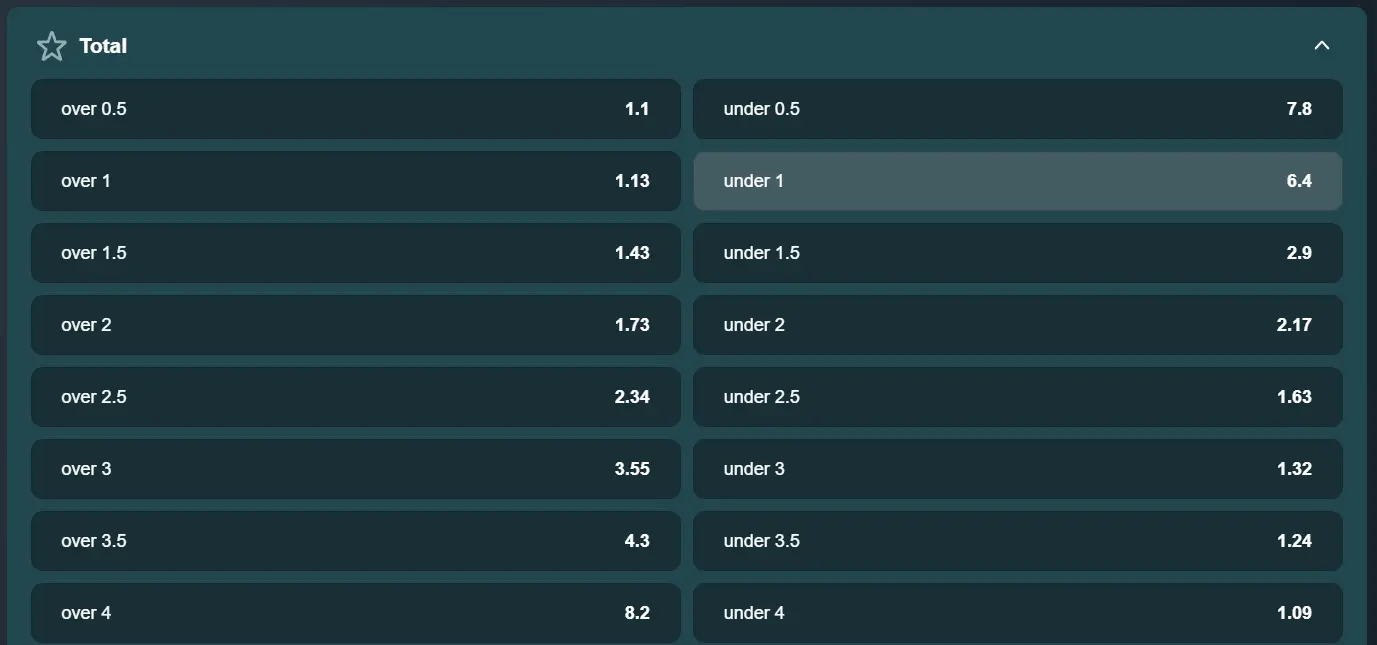
Common Over/Under Lines
Different goal lines suit different match scenarios:
- Over/Under 1.5 Goals: Typically used for defensive matches or when strong defensive teams face each other
- Over/Under 2.5 Goals: The most common line, representing the average goal expectation across most leagues
- Over/Under 3.5 Goals: Reserved for matches featuring high-scoring teams or known attacking play styles
- Over/Under 4.5+ Goals: Rare lines for exceptional circumstances involving dominant attacking sides against weak defenses
Key Factors Influencing Goal Totals
Team-Related Factors:
- Tactical Approach: Does the team play possession-based football, counter-attacking, or high-pressing? Each style impacts goal likelihood
- Offensive Quality: Assess shot conversion rates, big chance creation, and expected goals data
- Defensive Vulnerability: Analyze clean sheet percentages, goals conceded per game, and defensive errors leading to shots
- Recent Form Trajectory: Weight recent performances more heavily than season averages, as form and confidence are dynamic
Match-Specific Considerations:
- Head-to-Head History: Some matchups consistently produce high or low-scoring affairs regardless of current form
- Match Importance: Cup finals and relegation battles often produce cagier, lower-scoring matches
- Fixture Congestion: Teams playing their third game in a week may lack the intensity for high-scoring encounters
- Managerial Changes: New managers often implement defensive stability before attacking fluidity
Bankroll Management for Over/Under Betting
Sustainable betting requires disciplined bankroll management:
Unit Sizing: Risk only 1-3% of your total bankroll per bet. This approach protects against inevitable losing streaks.
Flat Betting vs. Variable Staking: Most professional bettors recommend consistent unit sizes rather than chasing losses with increased stakes.
Record Keeping: Maintain detailed records of all bets including reasoning, odds, and outcomes. This data reveals your strengths, weaknesses, and true ROI.
Advantages and Disadvantages of Totals Betting
Advantages
Simplicity and Accessibility
Over/Under betting eliminates the complexity of predicting match winners, draw outcomes, or exact scores. You’re focused solely on whether total goals exceed or fall below a number, making it one of the most beginner-friendly betting markets.
Independence from Match Result
Your bet can win regardless of which team wins. A 3-2 victory and a 2-3 defeat both produce five goals, meaning Over 4.5 bettors win either way. This independence from result prediction approximately doubles your winning scenarios compared to traditional match betting.
Data-Driven Decision Making
Goal totals betting responds exceptionally well to statistical analysis. Metrics like expected goals (xG), shots on target, defensive efficiency, and historical averages provide concrete data points for informed decisions, unlike subjective factors that might influence match winners.
Reduced Impact of Individual Events
A controversial penalty, red card, or refereeing decision that decides a match result may not significantly impact goal totals. While these events matter, Over/Under bets are less vulnerable to single-moment outcomes that determine 1X2 betting predictions.
Diverse Market Options
Modern bookmakers offer numerous goal total variations: full match totals, first-half totals, team-specific totals, alternative lines (2.25, 2.75), and Asian total handicaps. This variety allows bettors to find optimal value and risk levels matching their analysis.
Disadvantages
Volatility and Late Drama
A single goal in stoppage time can instantly transform a winning bet into a loss. The 90+3′ goal that makes it 2-1 instead of 1-1 can be financially painful for Under bettors when the line is 2.5. This volatility creates emotional stress that some bettors struggle to manage.
Limited Odds Value
Popular Over/Under markets attract heavy betting volume, meaning odds are typically sharp with limited value. Finding consistent edges requires extensive research and specialization, unlike less efficient markets where casual analysis might suffice.
Unpredictable Variables
Weather changes, unexpected tactical adjustments, early red cards, or goalkeeper injuries can dramatically alter expected goal totals in ways impossible to predict. A match trending Under can transform after a 20th-minute dismissal opens the game up.
Player Availability Impact
Missing a key striker, creative midfielder, or solid goalkeeper can shift expected totals significantly. However, this information often emerges just before kickoff, when odds have already adjusted, limiting advantage unless you’re monitoring team news constantly.
Conclusion
Over/Under goals predicting combines accessibility with analytical depth, making it suitable for both novice bettors seeking simplicity and experienced analysts pursuing edges through statistical modeling. Success requires disciplined research, emotional control, and realistic expectations.
The unpredictability inherent to football means even the most thorough analysis cannot guarantee winning bets. However, a systematic approach focusing on value identification, bankroll management, and continuous learning significantly improves long-term profitability prospects.
Enjoy the game and good luck!
